





Sunlight is how the body knows what time it is

Darkness is not a mood. It’s an instruction.

The signal-to-noise problem
Why simple inputs can feel so powerful

Add your deal, information or promotional text


ARMRA® Founder & CEO Dr. Sarah Rahal on how light shapes the nervous system, timing, and resilience.
ARMRA® Founder & CEO Dr. Sarah Rahal on how light shapes the nervous system, timing, and resilience.
This morning I was standing at the kitchen counter before anyone else was awake. No overhead lights. No phone. Just that low winter sun coming in at an angle: quiet, specific, almost clinical in the way it made contact with the room.
It reminded me of something I return to often, especially in March, when people feel more tender, more depleted, more easily thrown off without being able to name why:
Light isn’t ambience. It’s information.
If that sentence makes you bristle, stay with me. This isn’t a belief system. It’s a well-described part of circadian biology: light and dark cue timing in the human nervous system.
We’ve been trained to think of ourselves as chemistry: hormones, enzymes, neurotransmitters. And yes, of course, that’s real. But it’s incomplete.
Because the body also runs on signals: electrical activity moving through nerves, chemical messengers circulating in blood, and timing cues coordinated by the brain’s circadian clock.
Light is one of the most powerful of those cues.
Light is not just something we see. It’s a spectrum of frequencies that conveys timing information to the body.
Morning sunlight, particularly early daylight, tells your system that it’s time to mobilize. Cortisol rises appropriately, not pathologically. Body temperature shifts. Alertness increases. Appetite, focus, and metabolic signaling begin to align.
This isn’t abstract. It’s circadian biology.
Your mitochondria, the energy centers of your cells, don’t operate randomly. Mitochondrial function follows daily rhythms, shaped by circadian clocks throughout the body.
When light, dark cues are consistent, cellular timing tends to run more coherently, including rhythms tied to energy production and recovery.
This is why morning sunlight feels different from overhead lighting: one carries timing context. The other is brightness without a clock.
Darkness tells the body that it’s time to repair and time to shift into night mode. Melatonin rises with darkness and is best known for sleep timing, but it also has antioxidant activity and interacts with mitochondrial processes in the research literature.
And melatonin isn’t only a “brain hormone.” It’s produced in other tissues; the gastrointestinal tract is a major extrapineal source with very high tissue concentrations.
But in modern life, we blur the signal.
We wake up to screens. We live indoors. We keep overhead lights and LEDs glowing late into the evening. And then we wonder why sleep is shallow, why stress feels sticky, why we’re tired but wired.
When this happens, the body doesn’t fail.
It compensates.
And compensation is expensive.
It costs you sleep quality. Recovery. Emotional resilience. Immune tolerance. Patience.
Not because something is wrong with you, but because your biology is adapting to the environment it’s reading.
There’s another layer here, and it explains why March often feels harder than we expect.
Your nervous system is designed to entrain, to synchronize, with coherent environmental signals. When those signals are clean, the system settles into a rhythm that feels calm but alert, regulated but alive.
When they’re distorted, the system stays in vigilance.
Many people spend most of their time in a low-grade activated state. Not because they’re anxious by nature, but because the environment keeps giving the body reasons to stay “on.”
Less daylight. More indoor time. More screens. More artificial light at the wrong time of day.
The signal weakens. The noise increases.
So the body compensates.
And you feel it as brain fog, irritability, low resilience, immune fragility, or the sense that you’re never quite restored.
This is why seemingly simple practices can feel disproportionately impactful in winter.
Morning sunlight before screens.
True darkness at night.
Periods of quiet without constant input.
These aren’t wellness hacks. They’re signal restoration.
When the signal is clear, the system recalibrates quickly because it already knows what to do.
Sometimes the most meaningful intervention isn’t adding more.
It’s removing interference.
If this month has you feeling off, don’t overthink it. Don’t make it a character flaw.
Assume your biology is asking for reinforcement.
Here are three ways to work with light right now:
If March has you feeling depleted, don’t push harder.
Calibrate.
Plug back in.
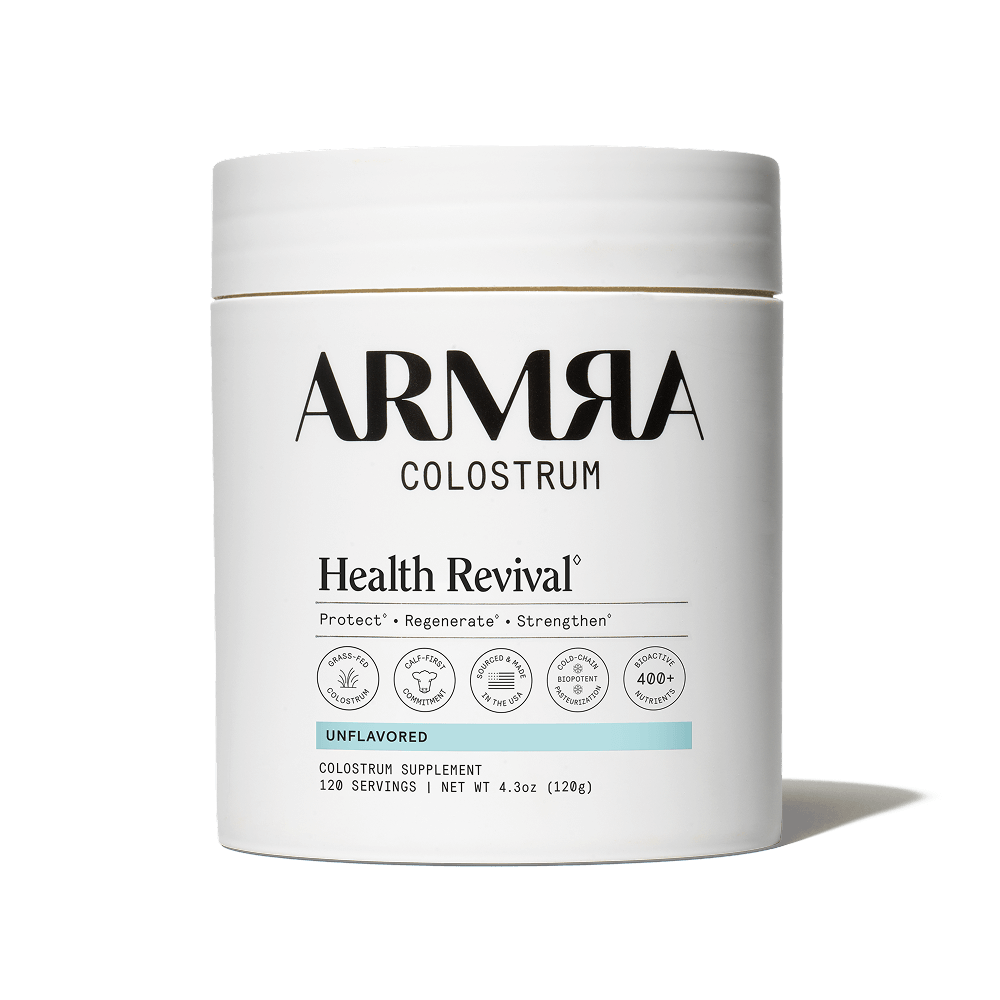
Let biology do what it already knows how to do. And this is where ARMRA Colostrum™ fits, not as a replacement for light, but as reinforcement for the systems that interpret it. Colostrum supports the gut barrier and normal immune function, two of the most signal-sensitive interfaces in the body, so when you give your system the right inputs (light, darkness, quiet), it can respond with more resilience.
—
Sarah Rahal, MD
ARMRA® Founder & CEO
Disclaimers
*These statements have not been evaluated by the Food and Drug Administration. This product is not intended to diagnose, treat, cure, or prevent any disease.

"Drink more water" is the oldest advice in wellness. It's also the most incomplete.
WRITTEN BY: ARMRA® EDITORIAL TEAM

Energy drinks are everywhere. But, what feels like energy is actually your body spending something it doesn't have.
WRITTEN BY: ARMRA® EDITORIAL TEAM


Your secret to becoming stronger, faster, and more resilient.
WRITTEN BY: ARMRA® EDITORIAL TEAM
Spoiler alert: real, lasting energy starts at the cellular level.
WRITTEN BY: ARMRA® EDITORIAL TEAM

Lush layers for inside-out revival.
WRITTEN BY: TESSA KAUPPILA

Cold and creamy, with a citrus finish.
WRITTEN BY: TESSA KAUPPILA


An immune-first, gut-deep look at hair growth, shedding, and why internal signaling matters more than surface solutions.
WRITTEN BY: ARMRA® EDITORIAL TEAM

Intestinal permeability explained through biology, not fear, and the barrier-first approach that supports long-term r...
WRITTEN BY: ARMRA® EDITORIAL TEAM

The biology behind seasonal allergies and why your immune system reacts the way it does.
WRITTEN BY: ARMRA® EDITORIAL TEAM

Sip into something transformative.
WRITTEN BY: TESSA KAUPPILA

Not a better soda. A stronger system. Your body’s blueprint, now in a can.
WRITTEN BY: ARMRA® EDITORIAL TEAM

Your immune system doesn’t need to be pushed harder. It needs the balance and coordination that allow it to respond w...
WRITTEN BY: ARMRA® EDITORIAL TEAM

Most supplements deliver ingredients. ARMRA Colostrum™ delivers bioactive intelligence.
WRITTEN BY: ARMRA® EDITORIAL TEAM

Heart coherence rhythms for stepping back into momentum, IRL.
WRITTEN BY: SARAH MURPHY

A science-backed look at why colostrum is biologically distinct from milk, and why its intelligence still matters today.
WRITTEN BY: ARMRA® EDITORAL TEAM

Fiber is everywhere. But according to ARMRA® founder Dr. Sarah Rahal, the real question isn’t how much you’re getting...
WRITTEN BY: ARMRA® EDITORIAL TEAM

A playlist designed to support regulated nervous system flow and steady daily vitality.
WRITTEN BY: SARAH MURPHY

Why the body’s first line of defense is also its first line of intelligence.
WRITTEN BY: ARMRA® EDITORIAL TEAM

We asked Mara Roszak, celebrity hairstylist and founder of ROZ Hair, to share the daily routines that keep her steady...
WRITTEN BY: KELSEY ABKIN

Breakfast fuels the body, but sunlight helps switch digestion and metabolism into daytime mode. Circadian biology sho...
WRITTEN BY: ARMRA® EDITORIAL TEAM

How rhythm, sound, and seasonal cues guide the nervous system, and why momentum follows.
WRITTEN BY: SARAH RAHAL, MD

Why digestion, hormones, and cellular energy must work together for metabolism to function smoothly.
WRITTEN BY: ARMRA® EDITORIAL TEAM

Peptides are everywhere. But according to ARMRA® founder Dr. Sarah Rahal, biology rarely works as simply as the trend...
WRITTEN BY: ARMRA® EDITORIAL TEAM

Why bloating isn’t just about food: the role of gut integrity in digestive comfort.
WRITTEN BY: ARMRA® EDITORIAL TEAM

Why health begins with communication at the cellular level.
WRITTEN BY: ARMRA® EDITORIAL TEAM

How you protect colostrum determines whether it’s powerful or potentially pointless.
WRITTEN BY: ARMRA® EDITORIAL TEAM

Short month. Big energy. Our coast-to-coast community showed up in February.
WRITTEN BY: TESSA KAUPPILA

Spice, patience, and a little ceremony.
WRITTEN BY: KELSEY ABKIN

A classic comfort drink, served the way biology prefers it.
WRITTEN BY: KELSEY ABKIN


Best paired with an on-the-go ARMRA® elixir.
WRITTEN BY: TESSA KAUPPILA

Consider this a power pour.
WRITTEN BY: TESSA KAUPPILA

What “structured water” really means and how your body creates it.
WRITTEN BY: ARMRA® EDITORIAL TEAM

Learn what quantum entanglement reveals about system-wide communication in biology, and why coordinated signaling sup...
WRITTEN BY: ARMRA® EDITORIAL TEAM

Understanding the growth factors that guide muscle repair and metabolic health.
WRITTEN BY: ARMRA® EDITORIAL TEAM

Dr. Rahal built ARMRA® to bring the tool that saved her life into the hands of millions.
WRITTEN BY: ARMRA® EDITORIAL TEAM

Feeling bloated isn’t just about what you eat. It’s about how your gut communicates, protects, and adapts.
WRITTEN BY: ARMRA® EDITORIAL TEAM

Dr. Rahal shares her favorite science-backed daily practices for true vitality.
WRITTEN BY: ARMRA® EDITORIAL TEAM

Feeling overstimulated and undercharged? You’re not burnt out; you’re biologically disconnected.
WRITTEN BY: ARMRA® EDITORIAL TEAM

Your gut is more than a digestive organ. It's one of the body’s major command centers.
WRITTEN BY: ARMRA® EDITORIAL TEAM

Most people think immunity lives in the blood. The truth is, it begins at the surface.
WRITTEN BY: ARMRA® EDITORIAL TEAM

Your body is talking. The science of feeling in sync starts with listening.
WRITTEN BY: ARMRA® EDITORIAL TEAM

These microscopic messengers don’t just support your cells. They teach them how to thrive.
WRITTEN BY: ARMRA® EDITORIAL TEAM

Dr. Sarah Rahal answers one of the questions she hears most.
WRITTEN BY: SARAH RAHAL, MD

Colostrum is one of nature’s most misunderstood whole-food inputs. Here’s the truth behind the myths and why ARMRA Co...
WRITTEN BY: ARMRA® EDITORIAL TEAM

Why artificial light indoors can stress your biology long before you step outside.
WRITTEN BY: ARMRA® EDITORIAL TEAM

Winter is a double-edged sword: it asks more of your body, and in that demand, your biology adapts and strengthens.
WRITTEN BY: ARMRA® EDITORIAL TEAM